What Does Healthy Stool Look Like?
How often should you go to the bathroom, and what shape, color, and consistency should a healthy person's stool have, and how much should there be? The quality of your stool reveals a lot about your overall health. However, talking about it is still considered taboo in society. Let's break that taboo.
How often should you go to the toilet, what shape, colour and consistency should a healthy person's stool be, and how much stool should there be? The quality of your stools tells a lot about your overall health. However, talking about it is still taboo in society. Let's break it.
If your digestion is not right, life is worth ????. We can certainly agree on that.
Both too frequent and too infrequent stools are uncomfortable for you. And most importantly, it indicates that all is not well in your body. Therefore, pay attention to your stool and note its usual form, as well as various deviations from normal.
How often should you go to the great need?
With healthy digestion, you should go to the big one every day. It is considered ideal to go one to three times a day. People who only go to the big one once every two days can also benefit.
The important thing is to monitor your normal state as well as any deviations from it. What is normal for one person may mean something is wrong in the body for another.
What is the shape of a healthy stool?
If you look around occasionally before flushing, you've probably noticed that the shape and color of your stool isn't always the same. This is primarily influenced by the state of your microbiome, what you eat, how much you eat, and how you eat it.
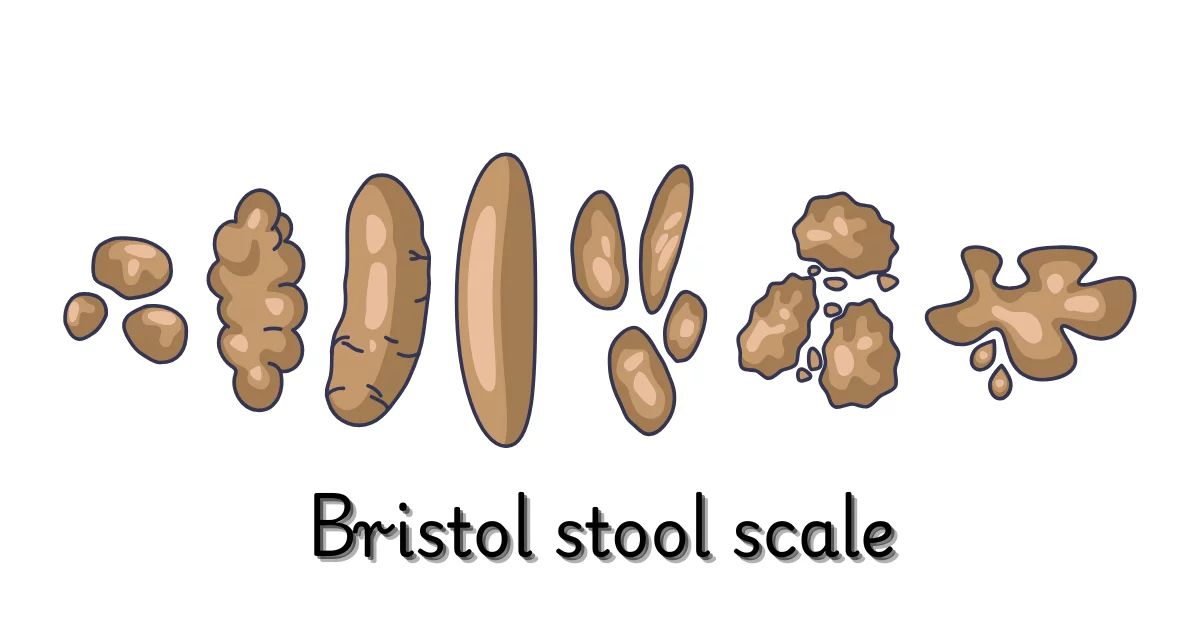
In medicine, the so-called Bristol scale is used to track healthy and unhealthy stools, which describes 7 types of stool based on hardness. We consider stools of types 3 and 4 to be healthy.
If you have stools of any other type for a long time, you have intestinal dysbiosis. Dysbiosis is an imbalance in the composition and especially the functionality of the microbiome. This affects all components of your health. Unhealthy stools are therefore not only a signal of impaired digestion, but also an overall indicator of impaired health.
- type 1: hard lumps that are difficult to pass (constipation)
- type 2: sausage shape with lumps
- type 3: sausage shape with cracks on the surface
- type 4: smooth, soft sausage/had
- type 5: soft lumps with separated edges
- type 6: fluffy lumps with irregular edges (diarrhoea)
- type 7: watery stools without solid parts (acute diarrhoea)
They are illustrated in the following figure. You can classify your stool by it after just a cursory glance.
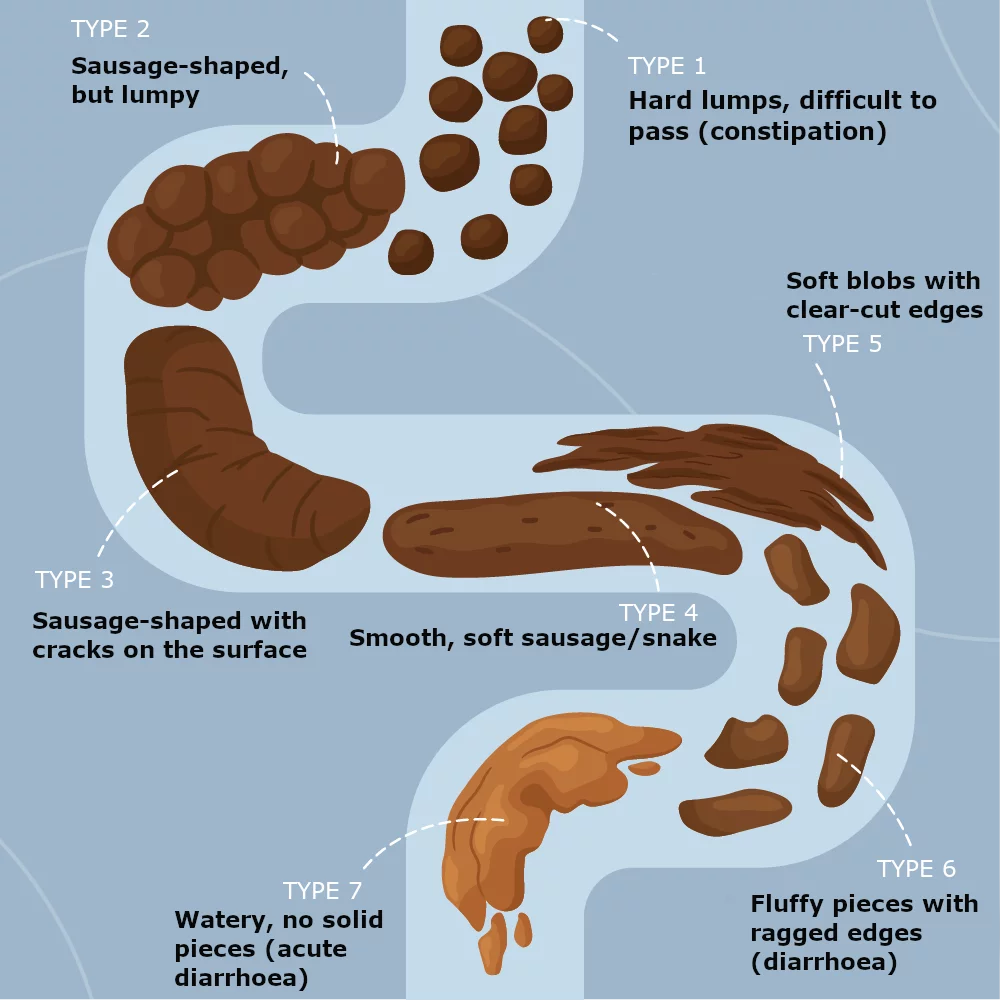
Types 1 and 2 signal constipation. Stool passes through the intestines too slowly, so its residues remain in the body longer than they should. Often this indicates a dysbiosis of the gut microbiome (type 1). This can be effectively corrected with appropriate probiotics.
Type 2, on the other hand, indicates insufficient fibre and water intake. Add more fruit, vegetables, legumes and cereals to your diet and keep an eye on your drinking regime. If you can't get enough fibre from your diet, a suitable dietary supplement may help.
However, lack of fibre can also cause soft lumpy stools (type 5).
Types 6 and 7 are referred to as diarrhea. They arise when food passes through the intestines too quickly1 so that firmer stools do not have time to form. With diarrhoea, nutrients are also not absorbed and there is a risk of dehydration. Diarrhoea is often caused by a variety of infections, some of which can be very serious.
By checking your stool every day, you will be able to see if there is anything going on in your body that needs attention.
What colour is normal stool?
The basic colour is various shades of brown.
The colour of your stool changes depending on what you eat. Red stools (and urine) tend to be red after beetroot, green after leafy vegetables. Black stools are sometimes caused by medications and dietary supplements to replenish iron.
However, long-term unhealthy discoloration may indicate a digestive disorder or a serious health problem. Don't underestimate it and see a doctor.
Little food = little stool?
The amount of stool depends on the type of food rather than the amount of food.
Vegetables contain a lot of indigestible fibre, which also absorbs water in the intestines, which is why there is a lot of stool from vegetables. If you are deficient in fibre, you are likely to have fewer stools.
Older research2 has shown that the average stool weight of Europeans is up to 200g, whereas in Asia and Africa the average weight can be up to twice that.
Do you find that after leaving the toilet you suddenly feel a few pounds lighter? Resist the urge to step on the scales. The loss is minimal.
How to fix your stool
The basic rules that help healthy digestion can be summed up in four points:
- healthy, high-fibre diet
- sufficient drinking
- regular exercise
- a varied and functional microbiome
keep these rules in mind and make sure your digestion is regular. If adjusting your diet is not enough, help yourself with probiotics or prebiotics.
Resources:
1 https://www.healthline.com/health/digestive-health/types-of-poop#color-guide
2 https://www.gastrojournal.org/article/0016-5085(92)91435-7/pdf