Up to 80% of your immunity resides in your gut – take care of it.
Immunity, defense, or resistance is the body's ability to protect itself against attacks by harmful microorganisms or toxins. Its role is to recognize these dangerous stimuli, assess their harmfulness, and respond accordingly.
Immunity, defensiveness or resistance is the ability of an organism to protect itself from attacks by hostile microorganisms or poisons. Its role is to recognize these dangerous stimuli, evaluate their harmfulness and take action against them.
From school, you will remember that part of the immune system is the white blood cells that fight infections. A healthy body produces special antibodies that neutralize and destroy pathogens.
Then you probably also know that immunity is supported by various vitamins, minerals and other nutritional supplements.
80% of immunity is found in the gut
Less talked about anymore is the fact that the gut and a balanced microbiome play a key role in the immune system. Up to 80% of immune cells are found in the gut.
The gut is involved in immunity in several ways:
- A protective physical barrier: the intestinal wall and a balanced microbiome prevent harmful substances from entering the bloodstream. [1]
- The immune cell trainer: It makes your immunity react only in case of danger.
- Creation of special substances: beneficial bacteria create vital substances that are difficult to supply from the outside. The best example is butyrate.
Although you may have never heard of butyrate, it performs several important functions in the body:
- it is involved in reducing inflammation,
- keeps immune reactions in check,
- regulates the permeability of the intestines so that only nutrients, not toxins, pass through,
- it is necessary for the production of intestinal mucus, which is home and food for anaerobic micro-organisms.

How training and defense in the intestines takes place
The microbiome trains immune cells by teaching them to distinguish harmful pathogens from harmless substances and microorganisms. This prevents the immune system from overreacting, which could result in allergies and autoimmune diseases.
The intestinal mucosa is composed of three different structures, each of which has a different role in the immune system:
- The mucus layer on the surface of the epithelial cells is the first line of defense of the body's physical barrier.
- The epithelium forms the second physical barrier and is directly involved in immune surveillance of the gut. In addition to direct defense, it also sends signals to the immune system that trigger the production of cytokines and chemokines.
- The lamina propria, made up of B and T lymphocytes, constitutes the lower layer. Its role is to trigger inflammatory and anti-inflammatory reactions. [1]
How bacteria work in the body
Up to 2,000 different species of microorganisms live in the human gut . Each has a different function and a different mechanism of action. Science has made great strides in recent years in the study of the microbiome. However, we are still only able to tell exactly how they work for a fraction of the species.
One of the best described strains commonly found in the microbiome is Lacticaseibacillus rhamnosus CRL1505. Let's take a closer look at what it does in the body and why you want it to be abundant in your gut.
How Lacticaseibacillus rhamnosus CRL1505 works
The probiotic strain Lacticaseibacillus rhamnosus CRL1505 triggers the mobilization of immune defense cells from the gut into the respiratory tract. This increases the production of cells in the lungs and intestines that control the immune response and the readiness of the fight cells to destroy pathogens that enter the lungs or intestines from the outside.
This creates a protective shield against respiratory and intestinal infections.
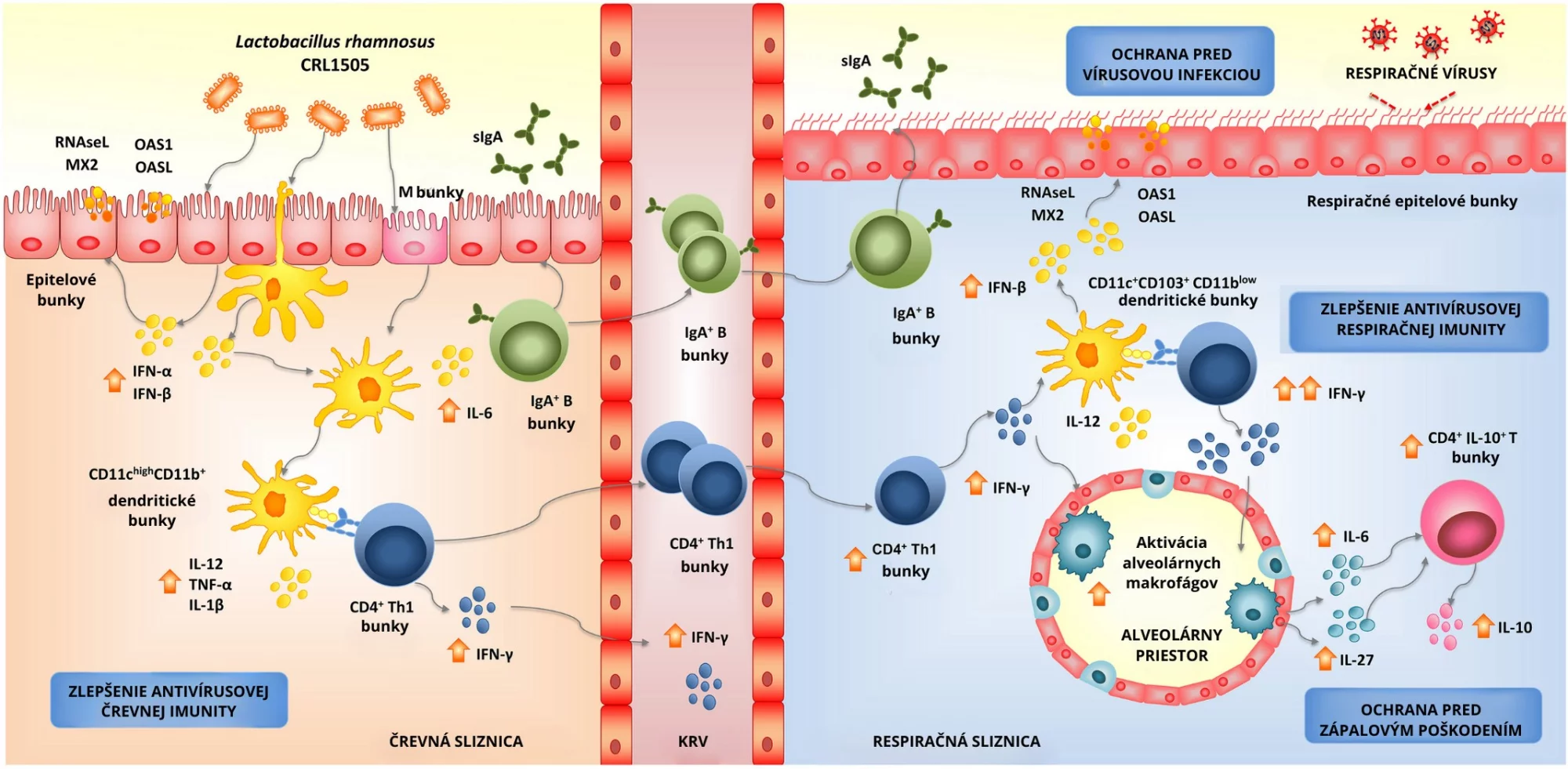
It may be easier to imagine it this way: Lacticaseibacillus rhamnosus CRL1505 mobilizes defense, command, allies, and attack.
The “trainer” enters the gut and sets up camp on the gut lining, as if arriving at the border of our state – the body. There, allies disguise it and sneak it through the barrier into the layer where part of the immune system is concentrated. From there, on one hand, it trains defensive immunity on the gut surface, and on the other hand, another part of the immune system is mobilized to the lower layer of the respiratory immune barrier. There, it trains a special attack unit to destroy pathogens from the outside. Isn’t that amazing?
Watch out for relatives with different properties
We would like to point out one more important thing.
Bacteria have a three-part name. The first indicates the genus (e.g., Lacticaseibacillus), the second the species (rhamnosus), and the third the strain (CRL1505). This hierarchy is similar to dog (genus) – domestic dog (species) – Yorkshire Terrier or Rottweiler (breed; in bacteria, strain).
And that makes all the difference!
Individual strains (like breeds) within the same species (e.g., Lacticaseibacillus rhamnosus) differ more than you might imagine.
For example, Lactobacillus rhamnosus LGG shares only 20% of its nuclear DNA with its counterpart Lactobacillus rhamnosus GR-1.
For comparison, humans share 60% of their DNA with a banana. The similarity between two strains of the same species can therefore be up to three times less than the similarity between a human and a banana.
So it is no surprise that bacteria of the same species but different strains act very differently in the body.
When choosing a probiotic, never settle for “just a lactobacillus” or “Lactobacillus rhamnosus.” To make an informed choice, you must also know the strain. If the manufacturer does not provide it, choose a different product.
What happens when gut balance is disrupted?
When gut balance is disrupted, the gut barrier often weakens as well. It is as if the mortar in the walls of your house has loosened. In such a house, there will be drafts, and many unwanted visitors can enter easily. In the gut, harmful substances can enter the body (e.g., through the bloodstream), unnecessarily triggering immune responses and causing systemic inflammation.
Significant microbiome imbalance (dysbiosis) has been observed in patients with inflammatory bowel diseases (Crohn’s disease, ulcerative colitis) and many other chronic conditions. [2]
Several studies have also shown a connection between a healthy microbiome and resistance to common respiratory infections.
Support your immunity
A healthy immune system is supported by: healthy diet with sufficient fiber, regular exercise and sleep, moderate cold exposure, and vitamin D supplementation. Recently, dietary supplements containing beta-glucans have also become popular.
For proper gut immune function, consider two factors:
A properly permeable gut lining and barrier. Prebiotics like Mikrobióm+ have proven very effective in supporting this.
Support a healthy microbiome composition with sufficient bacteria to perform specific functions. The new probiotic iMunobiom+® combines:
- clinically validated probiotic strain Lacticaseibacillus rhamnosus CRL1505
- vegan vitamin D to train and strengthen immunity
- beta-glucans for optimal bacterial nutrition and immune modulation
iMunobiom+® = Lacticaseibacillus rhamnosus CRL1505 + vitamin D + beta-glucan
What you should know:
- iMunobiom+® adapts to your lifestyle and can be stored at room temperature.
- It does not produce histamine, so it is well tolerated by people with allergies and intolerances.
- You can take it even if you follow a vegetarian, gluten-free diet, intermittent fasting, or a ketogenic diet.
Order iMunobiom+® and stay fit even when your immunity is under pressure.
[1] https://link.springer.com/article/10.1186/s40779-017-0122-9
[2] https://www.sciencedirect.com/science/article/abs/pii/B9780081022689000100?via%3Dihub