Probiotics, prebiotics, postbiotics, psychobiotics… when will there finally be enough “-biotics”?
The supplement market is producing new “-biotics” faster than the evidence needed to justify them. We explain why a new name on the label does not automatically mean a better product—and what criteria are actually worth using when choosing one.
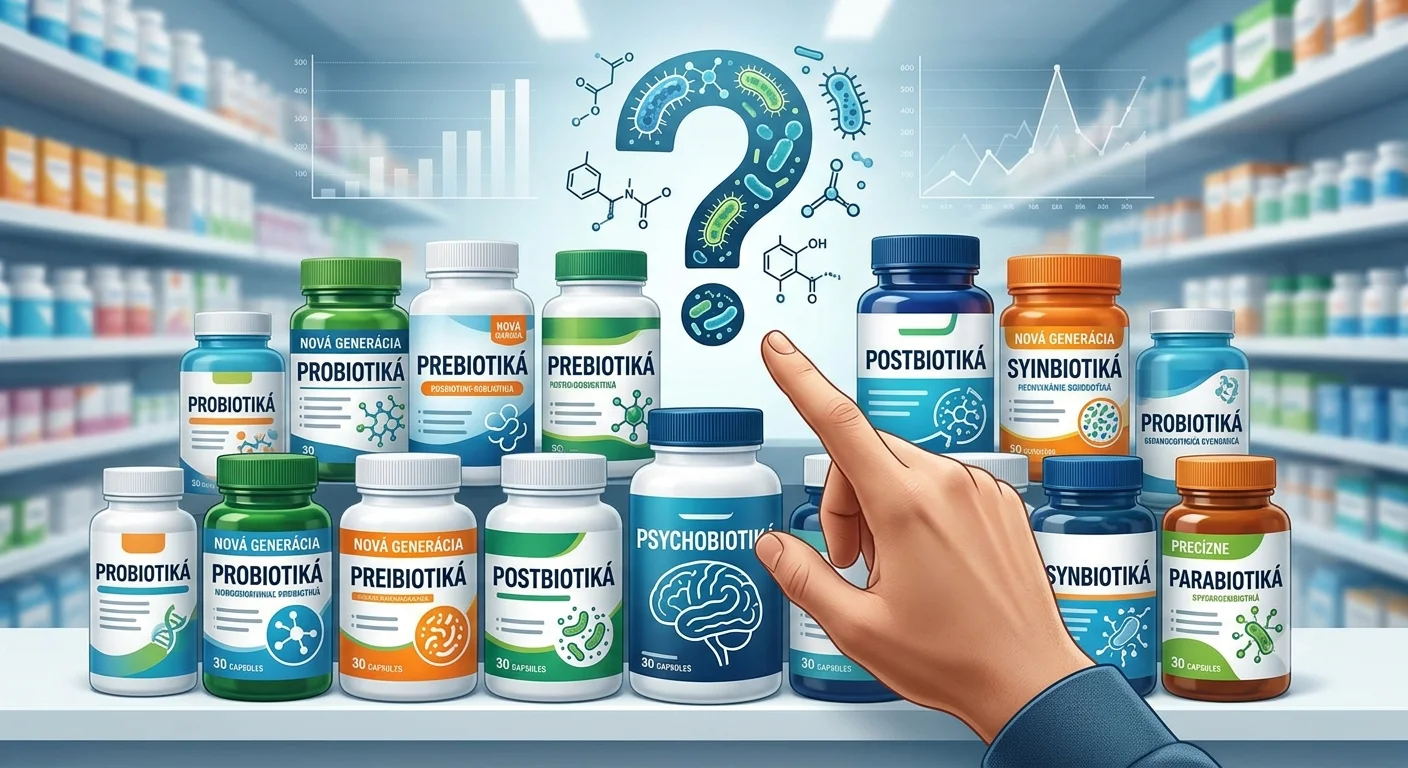
Take a look at the supplement aisle for digestion or immunity today. Probiotics, prebiotics, synbiotics, postbiotics, psychobiotics, parabiotics, “precision” probiotics, “next-generation” probiotics. Just a few years ago, you would hear two or three of these terms. Today there are dozens, and new ones appear every month.
At first glance, this may look like rapid scientific progress. In reality, it is something else: the vocabulary is growing faster than the evidence. And that is a problem that should concern anyone who wants to choose supplements rationally rather than based on whichever label sounds the most scientific.
Why are there so many new “-biotics”?
The suffix “-biotic” has become a marketing tool. It functions as a seal of credibility: add “-biotic” to something and it suddenly sounds like an established, clinically validated category. It creates the impression that years of research and a clear mechanism of action stand behind the product.
The problem is that a name is not evidence. Coining a new term takes an hour. Demonstrating that a category genuinely delivers measurable health benefits takes years of research. This is where the two diverge. New terms are appearing faster than the data needed to give them real meaning.
Definition inflation: when only the label remains
The original scientific definitions were strict. For something to be called a probiotic, it had to be shown to provide a specific health benefit when administered in adequate amounts. That requirement—demonstrated benefit—was the core of the definition.
On product packaging, however, this requirement often disappears. What remains is an attractive word. Calling a product a “psychobiotic” does not in itself prove that it affects mood. Having “postbiotic” printed on the box tells you nothing about whether, or how, it will actually help you. The name has become a promise that no one is obligated to fulfill.
Psychobiotics: real science, premature branding
The gut-brain axis is a legitimate and fascinating field of research. It is real, and scientists are actively studying it. The problem is not the research itself—the problem is how quickly early, preliminary findings have been transformed into a marketing category.
When a laboratory signal becomes a word on a package, marketing gets ahead of the science. Consumers read “psychobiotic” and expect benefits that have not yet been reliably established. The label is not selling evidence; it is helping to sell the product.
Postbiotics vs. parabiotics: a new word, almost the same concept
Some of these terms overlap so extensively that very few people can distinguish between them. Postbiotics and parabiotics largely describe similar preparations based on non-living microorganisms or their components. Having two names for nearly the same thing is not necessarily a sign of progress. Rather, it may indicate that terminology is multiplying faster than independently validated scientific realities.
Synbiotics: “packaged together” does not mean “working together”
A synbiotic is intended to be a carefully designed combination of beneficial bacteria and fiber that performs better together than separately. It is an appealing concept. However, putting two ingredients into the same capsule does not automatically guarantee that they support one another. Many products simply package together components whose interaction has never been demonstrated and market the result as synergy.
Questions every serious supplement should be able to answer
If you want to cut through the marketing fog, do not ask what kind of “-biotic” a product is. Ask questions that cannot be answered with a catchy label:
• Which specific strain? Knowing the bacterial species is not enough—most meaningful differences exist at the strain level.
• In what quantity? And is that quantity still viable when the product reaches you, or only on the day it was manufactured?
• For whom? In what population was it studied, and do you belong to that population?
• With what measurable outcome? What exactly improved, by how much, and for how long?
• Is it reproducible? Have the findings been confirmed by more than one study?
If there are no clear answers to these questions, no attractive label can compensate for their absence.
The solution is boring—and that is exactly why it works
Real credibility does not require new terminology. It requires transparent, sometimes almost boring details: which organism, which strain, what dose, how it is manufactured, who it was tested on, what was measured, what effect was observed, and how long that effect lasted.
That may be less exciting than a “revolutionary next-generation psychobiotic.” But it is the only thing that turns a supplement into something more than a marketing category. Progress is not demonstrated by inventing new names—it is demonstrated by data.
How we approach this at iProbio
At iProbio, we focus on exactly these “boring” questions. Drawing on more than 40 years of microbiome research, we prioritize what truly matters rather than chasing the latest buzzwords: the right strains, in the right amounts, viable at the moment they reach you.
We are not opposed to new terms. We simply believe that every term should mean something. If the next “-biotic” comes with robust, reproducible evidence, we will gladly embrace it. Until then, one simple rule applies—and you can use it when evaluating any brand, including competitors:
Show us the data.
Frequently Asked Questions (FAQ)
-
Not necessarily. Some terms are rooted in genuine scientific research. The problem is that a new label often appears on the packaging before there is reliable evidence to support its claimed benefits. What matters is the data behind the product—not the word printed on the box.
-
In simple terms, probiotics are live beneficial microorganisms, prebiotics are their “food” (primarily dietary fiber), and postbiotics are non-living microbial components or products. What matters most, however, is not which category a product belongs to, but whether it has demonstrated benefits for a specific group of people.
-
Ask about the specific strain, dosage, viability at the time of delivery, the population studied, and measurable outcomes. The more specific the answers you receive, the more credible the product is likely to be.
