Diverticulitis: When an Unwanted Inflammation Develops in the Intestine
Our digestive system is a fascinating yet delicate network. Sometimes, small anatomical changes can develop without causing any symptoms for years—until they suddenly make themselves known through sharp pain. This is the case with diverticulitis, a condition often regarded as a hallmark of the modern Western lifestyle due to its close association with our dietary and lifestyle habits (Fig. 1).

Figure 1: Difference between the presence of diverticula (diverticulosis) and their acute inflammation (diverticulitis).
Source: VectorMine / Getty Images
When patients start looking for information, they often come across three different terms: diverticulosis, diverticular disease, and diverticulitis. Before moving on, let's clarify the medical distinction between them (1) (Fig. 2).
💡 Educational Box: They Are Not the Same
- Diverticulosis: The presence of small pouches (diverticula) in the wall of the colon. It is usually asymptomatic and affects a large proportion of people over the age of 50 without them even knowing it (1).
- Diverticular disease: An umbrella term describing the condition in which these pouches begin to cause symptoms, such as chronic abdominal pain, bloating, or bleeding (1).
- Diverticulitis: The specific and most serious stage of diverticular disease. It refers to an acute inflammation or infection of one or more diverticula and requires prompt medical treatment (1).
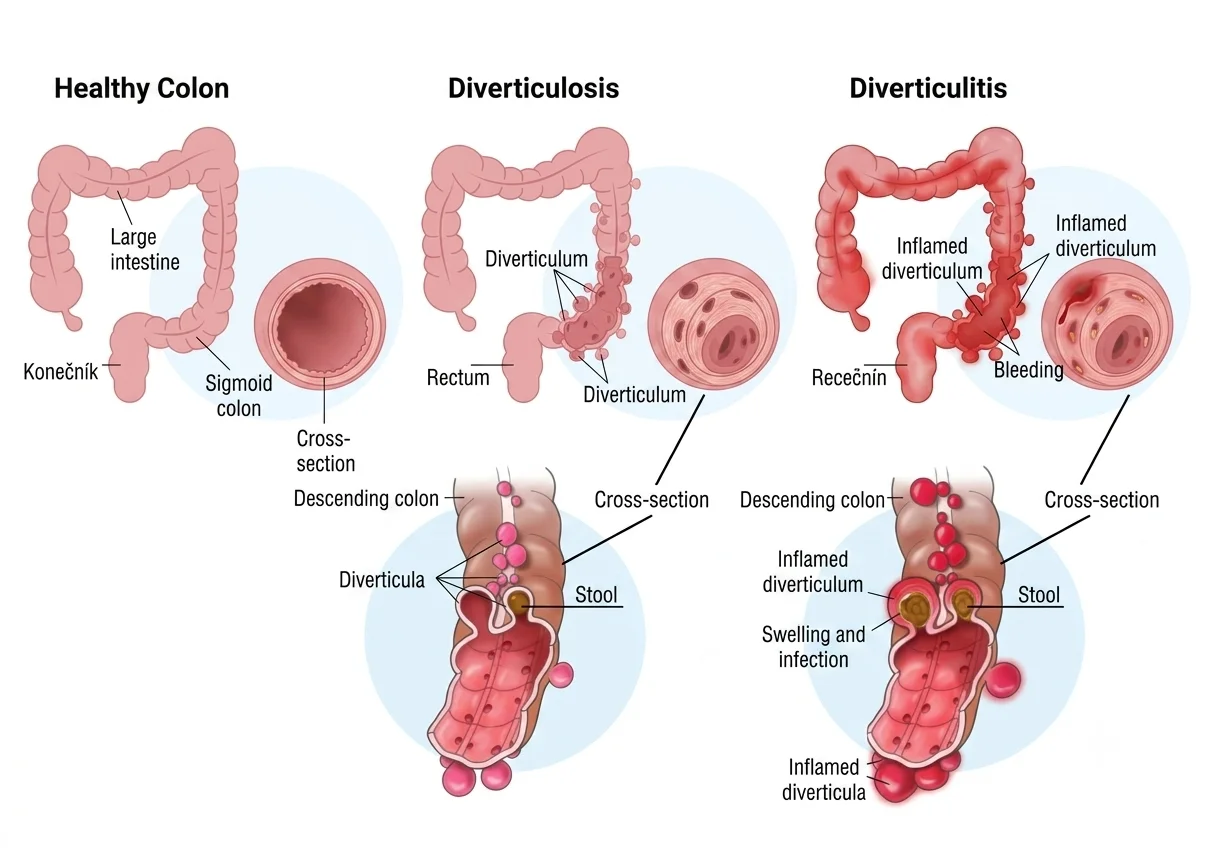
Fig. 2: Illustrative depiction of the differences between diverticulosis and diverticulitis at the intestinal level.
What exactly causes inflammation (diverticulitis)?
To understand diverticulitis, we need to look at what happens inside these pouches. They can be imagined as small protrusions or “balloons” that develop at weakened areas of the intestine (most commonly in the left sigmoid section of the colon) (2, 4).
The problem occurs when hardened stool becomes trapped in these micro-pouches or when mechanical irritation of the mucosa takes place. Combined with intestinal dysbiosis (an imbalance of the microbiome) and a weakened intestinal barrier, this can lead to the overgrowth of pathogens. The result is acute inflammation accompanied by severe lower abdominal pain (often on the left side), fever, nausea, and significant changes in bowel movements (2, 4).
Diagnosis and the great “intestinal detective work”
Diagnosing diverticulitis is not always straightforward because its symptoms can closely mimic other abdominal conditions (Table 1). Therefore, laboratory tests (elevated CRP and inflammatory markers in blood or stool) and especially abdominal CT imaging are essential for an accurate diagnosis. CT is currently the only method capable of reliably confirming inflammation within a diverticulum (1, 2, 3).
During diagnosis, physicians must rule out several other possible conditions. Let us look at how diverticulitis differs from its most common “look-alikes”:
Table 1: Symptoms of the most common abdominal diagnoses that may resemble diverticulitis. (In women, gynecological inflammatory conditions must also be excluded during diagnosis; in both sexes, conditions such as kidney stones may need to be considered.)
Condition | Where does it hurt? | Main difference compared with diverticulitis |
Diverticulitis | Most commonly lower left abdomen | Acute inflammation accompanied by fever and elevated CRP levels. |
Appendicitis | Typically lower right abdomen | Symptoms may be similar, but the pain is located on the opposite side of the abdomen. |
Different areas of the abdomen | A functional disorder – inflammation, fever, and elevated CRP levels are absent. | |
Inflammatory bowel diseases (IBD) | Entire abdomen, cramping pain | A chronic autoimmune condition (e.g., Crohn’s disease) with widespread inflammation of the intestinal mucosa. |
What are the treatment options?
Treatment depends on the severity of the condition (whether it is an uncomplicated or a complicated form):
- Conservative treatment (mild cases): In the past, antibiotics were routinely prescribed. However, current gastroenterology guidelines (e.g., AGA and WSES) recommend symptomatic treatment, adequate hydration, and bowel rest for otherwise healthy patients with uncomplicated diverticulitis, as the inflammation is primarily caused by microperforation and is often sterile rather than purely bacterial (2, 3).
- Antibiotic therapy: Antibiotics are reserved for high-risk patients (e.g., immunocompromised individuals) or for patients with worsening inflammatory markers or signs of systemic infection (2, 3).
- Surgical treatment: Surgery is indicated when complications develop, such as bowel perforation, fistula formation, intestinal obstruction, or abscesses that cannot be managed conservatively (3).
Supportive Therapy: The Power of Diet and the Gut Microbiome
Preventing future flare-ups (attacks) and promoting intestinal recovery after inflammation largely depends on our everyday lifestyle and dietary choices.
1. Dietary Management in Two Phases
- During an acute attack: A low-residue, easily digestible diet (liquid or soft foods) is recommended to allow the bowel to rest and recover (2, 3, 5).
- After the inflammation has resolved (remission): The opposite approach is recommended. A high-fiber diet (25–30 g of dietary fiber per day) becomes essential. Dietary fiber increases stool bulk, lowers intraluminal pressure within the colon, and accelerates intestinal transit, thereby reducing stool stagnation within diverticula (5).
2. Targeted Supplementation to Restore the Intestinal Mucosa and Gut Microbiome
After the acute inflammation has resolved, the intestinal mucosa remains weakened and the gut microbiome is often in a state of pronounced dysbiosis. Research suggests that successful recovery may benefit from several scientifically supported compounds:
- Galactooligosaccharides (GOS): This highly effective prebiotic fiber can selectively increase the abundance of beneficial Bifidobacterium species within as little as one week. More importantly, GOS also promote the growth of Faecalibacterium prausnitzii, one of the most important anti-inflammatory bacteria in the human gut. This bacterial species is consistently depleted in individuals with inflammatory bowel conditions. In addition, GOS help regulate bowel movements and reduce bloating, thereby decreasing mechanical pressure on weakened diverticula (4, 5).
- Digestive enzymes and dietary fiber (containing actinidin): Dried kiwi provides soluble dietary fiber together with the proteolytic enzyme actinidin. Actinidin significantly improves protein digestion in the stomach and small intestine, reducing the amount of undigested food reaching the colon, where it could otherwise undergo fermentation and support the growth of pathogenic bacteria within diverticula (6).
- Flavonoids: These potent antioxidants—particularly hesperidin and naringin—act as selective modulators of beneficial anaerobic gut bacteria. Their greatest benefit in diverticulitis appears to be their ability to stimulate the natural production of butyrate by the resident gut microbiota (4, 7).
- The importance of butyrate: Butyrate is a short-chain fatty acid (SCFA) that serves as the primary energy source for the cells lining the colon. It literally nourishes and promotes healing of the intestinal mucosa, strengthens mucosal immunity, and helps prevent increased intestinal permeability ("leaky gut"). A healthy intestinal barrier represents one of the body's most effective defenses against recurrent inflammation within diverticula (4, 8).
- Probiotics: Supplementation with selected probiotic strains—particularly combinations of Lactobacillus, Bifidobacterium, and the non-pathogenic strain Escherichia coli Nissle 1917—may help regulate the mucosal immune response and reduce colonization of diverticula by pathogenic microorganisms (4).
- Anti-inflammatory nutrients: Studies also suggest that maintaining adequate vitamin D3 status (9), together with supplementation with omega-3 fatty acids (10), may help reduce the risk of progression from diverticulosis to active diverticulitis while supporting overall disease management and quality of life (11).
Education and understanding the processes occurring within our bodies are the first steps toward regaining control of digestive health. In the long term, maintaining a healthy intestinal barrier is an investment that consistently pays off.
References and Recommended Scientific Sources:
- Bateman, A. C. (2013). Miscellaneous disorders of the large intestine. In: Shepherd NA, Warren BF, Geraint T. Williams FT, Greenson JK, Lauwers GY, Novelli MR. (eds) Morson and Dawson's Gastrointestinal Pathology. 5th ed. London: Wiley-Blackwell, 2013, pp. 748–762. ISBN: 9781405199438. https://www.researchgate.net/publication/297863836_Morson_and_Dawson's_Gastrointestinal_Pathology_Fifth_Edition
- Peery, A. F., et al. (2021). AGA Clinical Practice Update on Medical Management of Colonic Diverticulitis: Expert Review. Gastroenterology, 160(3), 906–911.e1. https://pmc.ncbi.nlm.nih.gov/articles/PMC7878331/
- Sartelli, M., et al. (2016). WSES Guidelines for the Management of Acute Left-Sided Colonic Diverticulitis in the Emergency Setting. World Journal of Emergency Surgery, 11, 37. https://pmc.ncbi.nlm.nih.gov/articles/PMC4966807/
- Tursi, A., & Papa, A. (2024). The Role of Gut Microbiota in the Pathogenesis of Diverticular Disease: Where Are We Now? Genome Medicine, 16(1), 153. https://pubmed.ncbi.nlm.nih.gov/39736798/
- Carabotti, M., et al. (2021). Role of Dietary Habits in the Prevention of Diverticular Disease Complications: A Systematic Review. Nutrients, 13(4), 1288. DOI: 10.3390/nu13041288
- Kaur, L., et al. (2010). Actinidin Enhances Gastric Protein Digestion as Assessed Using an In Vitro Gastric Digestion Model. Journal of Agricultural and Food Chemistry, 58(8), 5068–5073. https://pubmed.ncbi.nlm.nih.gov/20232890/
- Xiong, H. H., et al. (2023). The Interaction Between Flavonoids and Intestinal Microbes: A Review. Foods, 12(2), 320. https://doi.org/10.3390/foods12020320
- Recharla, N., et al. (2023). Gut Microbial Metabolite Butyrate and Its Therapeutic Role in Inflammatory Bowel Disease: A Literature Review. Nutrients, 15(10), 2275. https://pmc.ncbi.nlm.nih.gov/articles/PMC10221771/
- Maguire, L. H., et al. (2013). Higher Serum Levels of Vitamin D Are Associated with a Reduced Risk of Diverticulitis. Clinical Gastroenterology and Hepatology, 11(12). https://pmc.ncbi.nlm.nih.gov/articles/PMC3840074/
- Costantini, L., et al. (2017). Impact of Omega-3 Fatty Acids on the Gut Microbiota. International Journal of Molecular Sciences, 18(12), 2645. https://pmc.ncbi.nlm.nih.gov/articles/PMC5751248/
- Piotrowicz, G., et al. (2025). Managing Diverticula: Dietary Changes for a More Comfortable Life. Przegląd Gastroenterologiczny, 20(1), 92–101. https://pmc.ncbi.nlm.nih.gov/articles/PMC11966515/